The client already had reporting. What they lacked was a decision system that could turn SKU, channel, season, and inventory signals into price moves a merchant could trust. We built the intelligence layer and the workflow around it.
The business was optimizing inside disconnected spreadsheets, each with its own assumptions about elasticity, discount depth, and product substitution.
The pricing team needed recommendations that respected merchant judgment, brand constraints, inventory position, channel conflict, and regional demand patterns.
The model could not be a black box. Merchants needed to see why a move was recommended, what would break if assumptions changed, and where human approval was still required.
Demand response layer
We modeled demand sensitivity across product families, channel behavior, seasonality, and promotional depth, then exposed it as a reusable response layer rather than a one-off analysis.
Optimization harness
A scenario optimizer searched price and markdown moves against margin, inventory, and demand targets while enforcing business rules the team already used in planning meetings.
Merchant-facing review loop
The output was designed for operators: recommended move, expected tradeoff, confidence band, constraint violated, and the exact assumption a merchant could override.
- Started with a narrow category where the team had enough history to test elasticity assumptions.
- Compared recommendations against historical decisions before asking merchants to act on live scenarios.
- Expanded from price and markdown into promotion planning, wholesale pricing, and seasonal campaign support once the review loop held up.
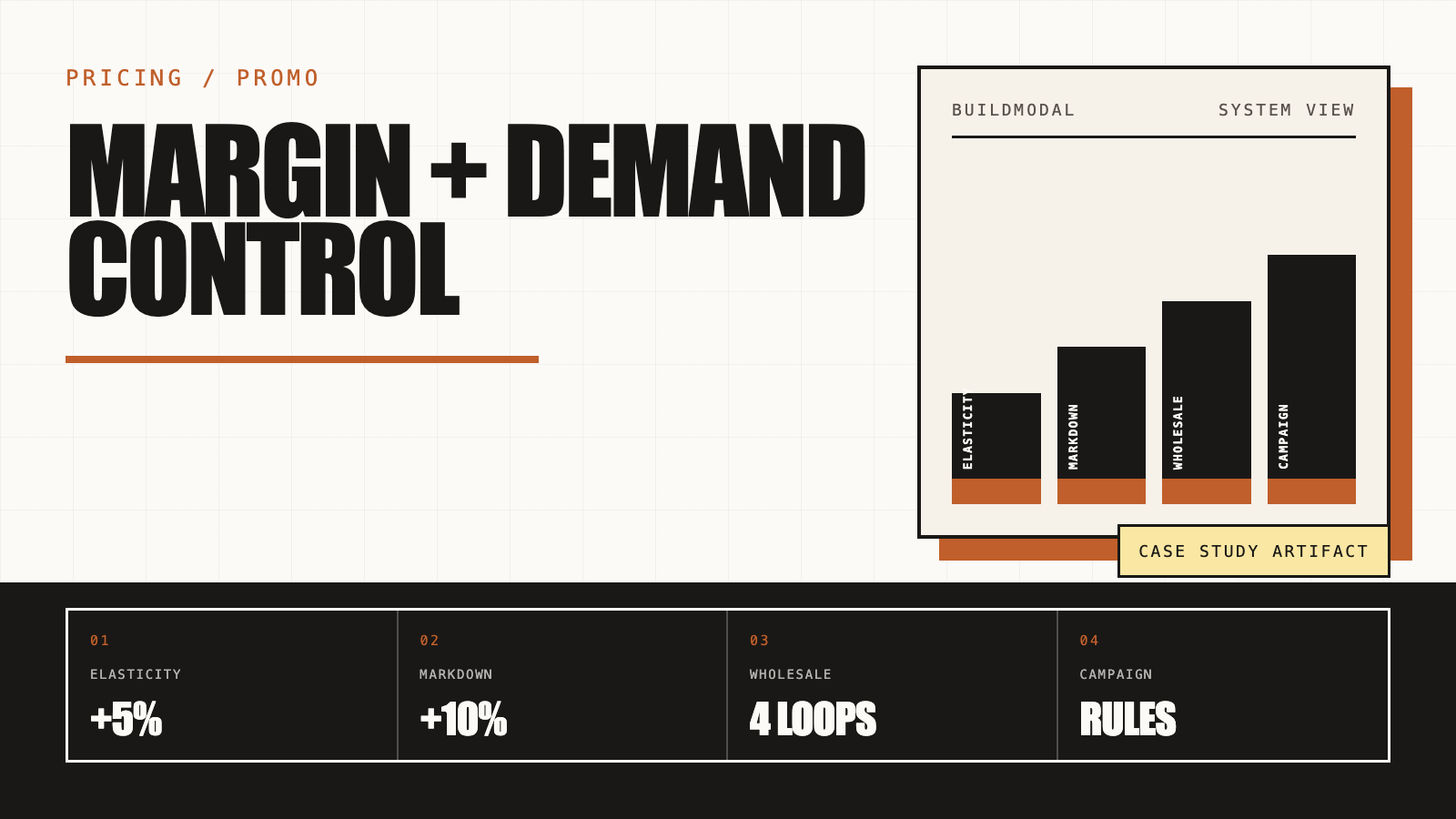
The system lifted net margin by roughly five percent while supporting a ten percent demand increase.
Planning conversations moved from subjective discount debate to scenario comparison with explicit tradeoffs.
The model became durable because business rules, overrides, and approvals were built into the workflow rather than bolted on afterward.
Pricing AI works when it becomes a decision system. The model matters, but the adoption comes from making every recommendation legible to the operator who owns the number.